HullGen
An AI system for generating and optimizing hull shapes for marine vessels. A single variant is produced in seconds, so a design team can compare dozens of them before triggering costly analyses.
HullGen is the first product of the New Science Lab team created in our workflow: geometry → physics → synthetic data → machine learning → verification → optimization → export.
Why early-stage hull design takes so long
Early-stage hull design is too slow, too costly, and limits the number of variants explored.
Conventional workflows require multiple iterations and expensive CFD analyses, that is, simulations of water flow around the hull. As a result, design teams compare too few variants, and poor decisions only surface at later, costlier stages of the project.
For both civilian and military marine vessels, this has direct consequences. Hull geometry affects drag, energy consumption, range, stability, and vessel behavior in a specific mission profile.
HullGen 1.0 in numbers
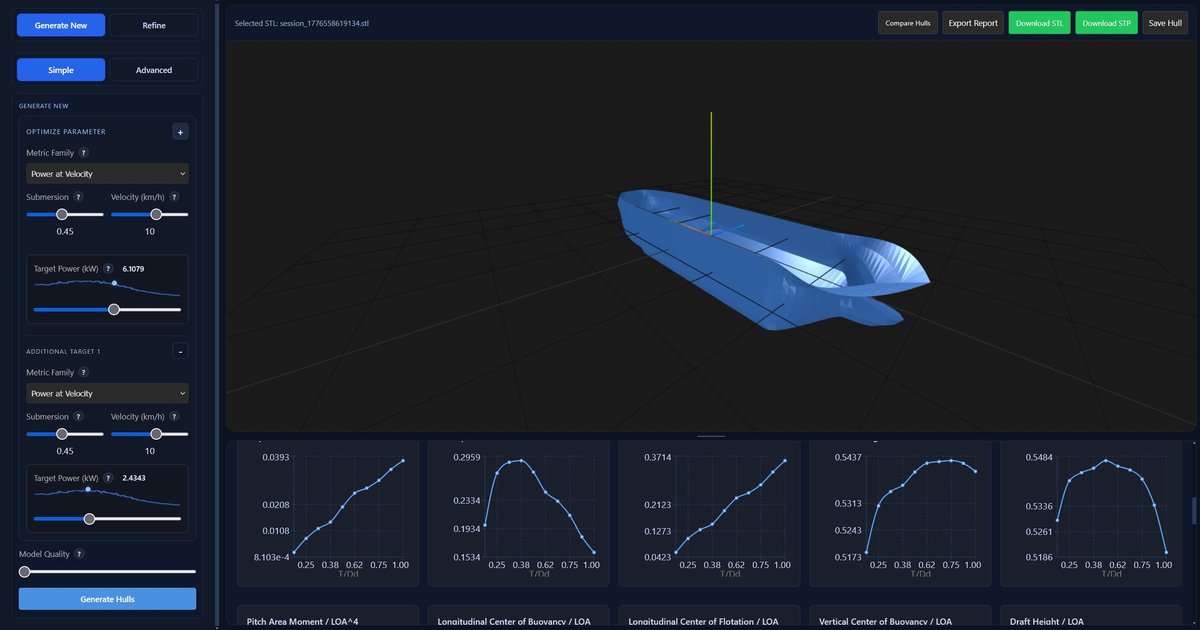
The HullGen 1.0 interface — input parameters, 3D visualization of the generated variant, and a review of output parameters.
Four steps
-
1
Input settings
The user sets their constraints on hull geometry, for example beam and side height, and defines the optimization objectives.
-
2
Variant generation
The system iteratively generates hull shape variants by navigating a structured parametric space, searching for shapes best matched to the defined objectives. Geometrically invalid solutions are discarded along the way.
-
3
Preliminary assessment
The result is a set number of hull versions, for example ten, that can be compared against the optimization objectives. Each variant is presented as a 3D visualization, together with an overview of all its performance parameters.
-
4
Result ready for further work
The user receives a package: 3D hull geometry (STL or STP file), run log, input and output parameters, and a seed identifier enabling full reproducibility. The geometry is ready for import into CFD tools and a CAD environment.
Where we are today
HullGen 1.0 is at TRL 4. That means a working integrated technology demonstrator in a laboratory environment. It is not yet a deployment-ready product.
The core elements of the system work connected in a single pipeline: a neural network trained on a dataset of 30,000 hulls, a multi-criteria optimization algorithm, constraint control verifying whether the hull is geometrically sound, and export and reporting.
The current version demonstrates that it is possible to move from selected input parameters to generated and comparable hull variants in a matter of seconds. An example result: a hull variant with approximately 27% lower wave-making resistance at the analyzed operating point (11 km/h); this is an internal result, prior to independent CFD and experimental validation.
We present a tool that can shorten the early design exploration phase and prepare better input for further analyses. HullGen does not replace the full design workflow, a complete CAD/CFD environment, final CFD analyses, or the end validation required before deployment.
What validation means for us today
At this stage, validation means four concrete things for us:
-
Repeatability
the same parameters lead to the same result within defined tolerance limits.
-
Auditability
every run is logged and reproducible.
-
Geometry control
the system does not promote physically unjustified solutions.
-
Reference comparison
results are benchmarked against reference data within a clearly defined scope of application.
What we are building now
We are currently building HullGen 2.0 on a new architecture, with small unmanned planing craft (USV) in mind.
As part of this work we plan to carry out independent validation in the future in cooperation with the Ship Design and Research Centre: CFD simulations and towing tank tests on physical models.
The letters of intent signed with Open Sea and Afleet confirm preliminary interest in the use of our technology in the area of unmanned vessels.
Where HullGen delivers the greatest value
HullGen's area of application is the design and optimization of hull shapes for marine vessels.
HullGen can support shipyard design teams and R&D teams in moving through a larger number of shape variants faster, before more expensive analyses are triggered. The result is a vessel better matched to a specific task, with reduced design time and lower cost of subsequent iterations.
For the end user, a better-matched hull for specific operating conditions translates to lower energy consumption, greater range, stability, and mission capability.
Application areas
-
Recreational yachts and commercial vessels
-
Special and technical vessels
-
Small unmanned surface vessels (USV) — within the scope of the HullGen 2.0 version under development
See HullGen in action
You can get acquainted with the current state of the HullGen technology demonstrator. The demo shows how the tool works, the optimization logic, and the form of output — not a final enterprise product.
The current demo is designed to show the technological direction and process architecture. Not all elements of full validation and high-fidelity simulations are yet integrated. Some current predictions are Proof of Concept in nature and will be developed toward greater reliance on additional data and more advanced simulations.
During the presentation we show:
-
setting input parameters,
-
launching the optimization process,
-
early visualization of the generated variant,
-
review of output parameters, including the drag curve as a function of speed,
-
comparison of output parameters to similar vessels from the database,
-
export of results, including an STL or STP file.
We also discuss the current state of the solution, the scope of meaningful use, and our development plans.